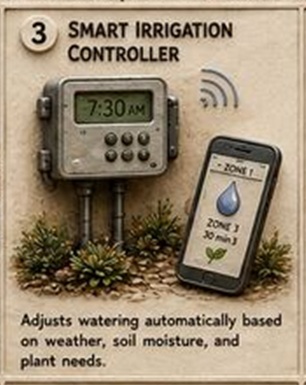
People ask this question as if it were a choice between two versions of the same thing. It isn't. These two upgrades operate on completely different variables, which is why the comparison confuses people and why some homeowners end up buying the wrong one first.
Here is the cleanest way to think about it:
- A smart controller changes when and how long you water. It's a brain.
- Drip irrigation changes where the water goes. It's plumbing.
A dumb timer running drip lines still overwaters. A smart controller running old spray heads still throws water at your sidewalk. Fixing one does not fix the other.
Side by Side
| Smart Controller | Drip Irrigation | |
|---|---|---|
| What it fixes | Watering at the wrong time, for too long, or when it just rained | Water lost to evaporation, runoff, and hitting hardscape instead of roots |
| Relative cost | Lower. Usually a single device plus setup | Higher. Materials and labor scale with the size of the yard |
| Install effort | Hours. Swaps in where your existing timer sits | Days for a full conversion, and it means digging |
| Time to payback | Faster, because the upfront cost is small and savings start on day one | Slower upfront, but the savings are larger and permanent |
| Upkeep | Firmware updates, occasional schedule tuning, Wi-Fi that sometimes sulks | Emitters clog and need periodic checking, lines can be damaged by digging or pests |
| Best for | Any yard still running on a fixed timer | Planted beds, trees, shrubs, and gardens |
| Weakness | Cannot improve bad delivery. Smart scheduling of a wasteful sprinkler is still wasteful | Cannot decide when to run. Without good scheduling it happily overwaters efficiently |
The verdict, if you can only do one
Install the smart controller. It costs less, goes in faster, and addresses the single most common source of waste in desert yards, which is irrigation running on a schedule that ignores the weather. Then convert to drip when you are already opening up the landscape, replacing failing lines, or redoing the planting beds. Doing drip during a landscape project rather than as a standalone job is what keeps the cost reasonable.
Why the "Argues With Your Phone at 6am" Problem Is Real
Smart controllers are genuinely good, but they are connected devices, and connected devices have opinions. Expect to spend some time in an app during the first few weeks getting zones and plant types set correctly. A controller configured wrong is just an expensive timer. This is the most common reason people feel underwhelmed by theirs, and it is a setup problem rather than a product problem.
Drip has the opposite personality. It is quiet, unglamorous, and requires nothing from you until an emitter clogs. Check the lines seasonally and it will outlast several controllers.
The Combination Most Well-Designed Systems Actually Use
Drip lines delivering water to roots, a smart controller deciding when each zone runs, and the yard divided into hydrozones so plants with similar water needs share a schedule. Add soil moisture sensors and the controller stops guessing entirely.
That is the full stack, and you do not have to buy it all at once. Each piece works on its own and each one makes the next one better.
Get a Real Number for Your Yard
Generic comparisons only go so far. Answer a few questions about your yard and irrigation and get an estimate of your water waste and savings, free.
Assess My Home → Talk to a Local Pro →One Last Thing About Rebates
Rebate programs vary by city and they change, so check before you buy rather than after. Our rebates page lists what is currently available across Tucson, Phoenix, Albuquerque, Las Vegas, Los Angeles, and San Diego. In Tucson the largest programs are rainwater harvesting and lawn removal, so if either of those is on your list, sequencing them with your irrigation work is worth planning around.